










DYNAMIC EVENTS LIMITED

BLOG

Image: Freepik

In the fast-paced world of business, hosting successful events can be a game-changer for establishing connections, showcasing products, and boosting brand visibility. However, to ensure your event stands out and achieves its objectives, meticulous planning and execution are paramount. Here are some essential tips to help you navigate the intricacies of event planning and hosting.

Accommodating Diverse Dietary Needs

Prioritizing inclusivity goes beyond mere consideration — it’s about actively ensuring all attendees feel welcome and valued. Offering a diverse range of food options not only caters to various dietary preferences but also demonstrates your commitment to meeting the needs of all guests. Collaborating with catering services that specialize in providing allergen-friendly, vegan, and gluten-free options is a proactive step toward ensuring everyone can enjoy the culinary experience. Moreover, prominently labeling food items with clear ingredient lists helps attendees make informed choices, fostering a positive and inclusive atmosphere throughout the event.

Strategic Marketing on Any Budget

Effective event promotion doesn’t have to drain your budget; it’s about leveraging available resources creatively and strategically. Social media platforms offer a cost-effective way to reach a wide audience, allowing you to create engaging content, run targeted ads, and encourage user-generated buzz through hashtags and interactive posts. Email marketing remains a powerful tool for nurturing relationships with potential attendees, providing updates, exclusive offers, and reminders leading up to the event. Collaborating with local businesses or industry influencers can amplify your reach and credibility, tapping into their established networks and enhancing the event’s visibility within your target demographic.

Integrating Technology

In today’s digital age, embracing technology is not just a convenience but a necessity for successful event management. Event management software streamlines administrative tasks such as registration, ticketing, and attendee tracking, saving time and reducing the risk of errors. Mobile apps offer a convenient way for attendees to access event information, engage with speakers or exhibitors, and provide real-time feedback, enhancing their overall experience. Virtual event platforms have gained prominence, offering opportunities for hybrid or fully online events that transcend geographical boundaries, accommodating remote attendees, and maximizing participation.

Preparing for Contingencies

Meticulous planning is vital, but preparing for contingencies is equally important for seamless event execution. A comprehensive contingency plan involves identifying risks like inclement weather or technical issues and outlining mitigation steps. Securing backup venues, suppliers, and clear communication with stakeholders ensures swift adaptation and maintains trust in your event management abilities.

Securing Professional Speakers or Entertainers

The success of your event hinges significantly on the quality and relevance of the speakers or entertainers you choose. Investing in experienced professionals who possess not only expertise but also charisma and the ability to engage and inspire your audience is paramount. Thorough research and vetting ensure alignment between their expertise and your event’s theme, ensuring their contributions resonate with attendees and reinforce your event’s objectives. Additionally, establishing clear expectations and providing adequate support and resources to speakers or entertainers sets the stage for a seamless and impactful performance, leaving a lasting impression on your audience.

Streamlined Online Registration

Online registration should prioritize simplicity and accessibility to enhance the attendee experience and boost participation. User-friendly platforms accessible from any device remove barriers and promote early sign-ups. Additionally, collecting attendee data enables personalized communication and allows for effective measurement of marketing success, while automated emails and reminders ensure engagement and organization throughout the registration process.

Successful event planning and hosting demand meticulous attention to diverse dietary requirements, technological integration, and impactful marketing approaches. Incorporating these crucial elements ensures an elevated event experience, bolstering brand reputation and fostering meaningful connections. By implementing these strategies, businesses can confidently achieve their objectives and leave a lasting impression on attendees.

Explore the magic of Malta’s events with Dynamic Events—contact us today to start planning your unforgettable experience!

Middle East oil exports return to pre-war levels, excluding Iran

Oil exports from the Middle East, excluding Iran, exceeded their pre-war average last week, Kpler data showed, as pipelines helped bypass the Strait of Hormuz despite continued attacks on shipping.

Despite attacks on ships in the Strait of Hormuz, crude oil exports from the Middle East Gulf region, excluding Iran, returned to pre-war levels in September, according to maritime tracking firm Kpler. The recovery followed changes to the region’s export routes.

“At least 16.5 mbd (million barrels a day) left the region between 1 and 28 September, matching the pre-war average excluding Iran. That is 10.5 mbd above March’s monthly average,” said the firm.

However, 40% of those exports now bypass the Strait of Hormuz, compared with 17% before the war, with pipelines in Saudi Arabia and the United Arab Emirates providing key alternative routes. Most crude crossing the strait changes tankers offshore.

The figures cover crude oil and condensate.

The export figures include shipments via the Red Sea, which exporters increasingly use to bypass Iran’s attempted blockade of Hormuz. Around a fifth of the world’s oil supplies passed through the strait before the conflict.

Oil prices remain well above their pre-war levels. International benchmark Brent crude futures for December delivery traded at $102.25 a barrel on Monday morning, while US benchmark West Texas Intermediate traded at $90.50 a barrel.

Brent futures were around $72 before the war. The disruption to shipping through the strait has sent shock waves through the global economy, prompting countries to scramble for alternatives and sending fuel prices soaring.

Iran continues to claim control over the waterway, and ships travelling without its authorisation risk attack. Nevertheless, more vessels are getting through, while alternative routes are operating at full capacity.

Despite the recovery in exports, experts warned that conditions remained far from normal. A US blockade of Iranian ports continues to restrict a large share of Iran’s own oil exports.

Saudi Arabia has benefited from the reopening of its East–West pipeline, which connects its main oil fields in the east to the Red Sea terminal at Yanbu, bypassing Hormuz.

The pipeline shut down on 11 September after strikes launched from Iraq and resumed operations on 22 September, Kpler analyst Amena Bakr said last week.

The UAE also has a route around Hormuz through its pipeline linking Abu Dhabi’s oil fields to Fujairah, a terminal on the Gulf of Oman outside the strait.

The recovery in exports comes as the seven core members of OPEC+, which comprises the Organization of the Petroleum Exporting Countries and its allies, including Russia, agreed on Sunday to leave their production targets unchanged for November, in line with expectations.

The seven countries produced about 25 million barrels of crude oil a day in August, up 630,000 barrels a day from July, according to OPEC’s September report.


 Creditline: Euronews Business


Schneider Electric shares plunge on record $22.6bn PTC deal

French energy technology group Schneider Electric has signed a definitive agreement to acquire Boston-based PTC for $22.6bn (€20.1bn) to expand its industrial AI business. The French company’s shares plummeted on Monday following the announcement.

Schneider Electric, one of Europe’s most valuable companies, saw its shares plunge after confirming an agreement to buy US-based industrial design software company PTC.

The deal is expected to be the largest acquisition in Schneider Electric’s history, as the company seeks to expand its industrial AI capabilities using product and engineering data.

The French energy technology group will pay $205 per share for 100% of PTC’s shares in cash, valuing its equity at $22.6bn (€20.1bn) and the business, including debt, at $23.7bn (€21.1bn).

The deal “creates a leading, scaled, open and interoperable industrial software and AI franchise”, Schneider said in a statement, adding that PTC’s board had agreed to the deal. The offer represents a 42.3% premium to PTC’s last closing share price.

Schneider said the deal would combine industrial software and AI to help customers design, manufacture, operate and maintain products more efficiently, using industrial data to guide decisions and improve performance.

Olivier Blum, chief executive of Schneider Electric, said: “The acquisition of PTC represents an important step forward in our ambition to lead the new era of Energy and Industrial Intelligence. Together, we are creating the industry’s most complete Software & AI powerhouse and highest-quality portfolio bridging the physical and digital worlds.”


The move comes amid concerns that advances in artificial intelligence could undermine software companies’ business models by offering cheaper alternatives to their services.

PTC’s valuation this year had fallen as low as 13.1 times the next 12 months’ earnings, according to MarketWatch, citing FactSet.

The publication cited analysts at Jefferies who warned that fears of AI disruption had depressed software valuations, allowing Schneider to buy PTC at a decade-low valuation, but could continue to weigh on Schneider’s shares after the deal.

PTC’s chief executive Neil Barua said: “We gain substantial scale and resources to accelerate innovation, advance our Intelligent Product Lifecycle vision, and expand our business into more geographies and end markets to serve more customers.”

The Boston-based company has more than 7,000 employees and serves more than 30,000 customers. It generated roughly half of its revenue in the Americas in its 2025 financial year.

Schneider expects to issue up to €17bn in debt and up to €6bn in new shares to pay for the deal.

The company said it expects annual cost savings of €250m by the third year after completion, alongside approximately €800m in additional revenue from combining the businesses.

Schneider also expects to pause share buybacks in 2027 and 2028, before accelerating purchases to complete its existing €2.5bn–€3.5bn programme by the end of 2030.

The deal is expected to close by the third quarter of 2027, subject to customary conditions, including approval from PTC shareholders holding at least a majority of its outstanding shares and the required regulatory approvals.

Schneider’s shares were down more than 9% in morning trading in Paris following the announcement.

 Creditline: Euronews Business


Euro hits 17-month low as French debt fears mount and Spain heads for snap election

The euro slid to its weakest level against the US dollar since May 2025 on Monday, as France’s debt troubles and Spain’s political turmoil, capped by a snap election call, fuelled fears of a fresh eurozone crisis and of contagion across the bloc’s bond markets.

The euro fell to a 17-month low against the US dollar at the start of the week, as fiscal and political risks in Paris and Madrid revived memories of the eurozone debt crisis.

The euro touched $1.1161 during Asian trading, after four consecutive weekly losses, and stood at around $1.12 at the European open, recovering slightly.

Analysts at Dutch bank ING warned in a note on Friday that the market could “easily add another 2% in risk premium to the euro” if the bond sell-off extended.

The spread between French and German 10-year bond yields stands at roughly 146 basis points, after the largest weekly increase in 17 years last week, according to data provider LSEG.

France’s 10-year yield rose to 4.917% in early trading on Monday, close to last week’s 24-year high, after closing Friday at around 4.856%.

French Finance Minister Roland Lescure insisted last week that France remained a solid borrower, unveiling a 2027 budget that aims to cut the deficit from 5.4% of GDP to 5%, ahead of next spring’s presidential election.

Spain added to the political uncertainty on Monday, when Prime Minister Pedro Sánchez called a snap general election for 29 November, after the parliament rejected two of his minority government’s housing decrees on Friday.

Spain’s 10-year yield was mostly steady between 4.07% and 4.09% on Monday morning, leaving its premium over German debt at around 65 basis points, less than half of France’s current gap.

Against this backdrop, European stocks were mixed at the open.

The Euro Stoxx 50 fell 0.4%, and the broader Stoxx 600 rose 0.6%.

France’s CAC 40 fell more than 1%, while Spain’s IBEX 35, which slipped into the red after Sánchez’s announcement, was 0.4% higher.

Meanwhile, Germany’s DAX, Italy’s FTSE MIB, the UK’s FTSE 100 and the Netherlands’ AEX traded between 0.1% and 0.3% higher.

Contagion fears test the ECB

Last week’s sell-off also hit Italian, Belgian and Greek bonds, while German debt drew safe-haven demand. Italy’s premium over Bunds neared 110 basis points on Thursday.

Analysts at Belgian bank KBC wrote in a note on Monday that there had been “clear contagion towards the likes of Belgium or Italy” since then.

The turmoil leaves the European Central Bank in a bind.

It has raised rates twice since June to tame inflation, which hit 3.8% in September, but traders have pared bets on more hikes.

Its Transmission Protection Instrument, a bond-buying backstop created in 2022, has never been used.

Speaking at a think tank event on Thursday, Joachim Nagel, head of Germany’s Bundesbank and a likely candidate for the ECB’s next presidency, said the central bank’s focus was price stability, not “certain spread levels”.

Asked about France, ECB President Christine Lagarde told French daily La Croix last week that “when your debt is close to 120% of GDP and not on course to be brought under control, it’s a serious matter”.

However, Lagarde asserted that “it’s not 2008 or 2011”.

Wall Street rallies after weak jobs data

US stocks climbed on Friday after the American economy added just 29,000 jobs in September, far fewer than expected, prompting traders to pare bets on a Federal Reserve rate hike in October.

The S&P 500 rose 0.7%, the Dow Jones Industrial Average 0.5% and the Nasdaq Composite 1.2%.

US futures were mostly flat on Monday, except for the Nasdaq-100, which was about 0.5% lower.

The minutes from the Fed’s September meeting are due on Wednesday.


 Creditline: Euronews Business

Why ordinary investors struggle to buy into the robotics boom

Most of the companies building the robots of the future are still private, leaving ordinary investors with limited options such as Tesla, diversified industrial groups or new vehicles like RoboStrategy, a Nasdaq-listed fund whose shares trade at more than twice the value of its assets.

Anyone hoping to bet on robots taking over factories, warehouses and homes runs into the awkward fact that shares of the start-ups at the centre of the frenzy cannot be bought on a stock exchange.

What is available is a carmaker betting its future on robots, industrial groups for which robots are one business among many and a new breed of listed funds charging handsomely for access.

Euronews breaks down the options ordinary investors currently have to gain exposure to robotics, and the risks each one carries.

Buying Tesla for the robots

Tesla is currently one prominent route. As Elon Musk said last year, about 80% of the company’s value will come from Optimus, its humanoid robot, while its robotaxis add another robotics angle.

Yet, buying Tesla today still mostly means buying a carmaker. Its automotive business generated $20.5 billion (€18.1bn) of its $28.2 billion (€24.9bn) revenue in the second quarter of this year, almost 75%, while Optimus has yet to record any sales.

“By the end of next year, I think we’ll be selling humanoid robots to the public,” Musk declared at the World Economic Forum in Davos back in January.

Tesla has since begun building the robot at its Fremont plant in California, but Musk has warned that “Optimus production will be extremely slow at first, as everything is new. This is not like making a car.”


FILE. Tesla’s humanoid robot Optimus distributes popcorn at a Christmas market stall during its presentation at a mall in Berlin, Germany, 20 Dec. 2025 


“Many Tesla investors own the shares to access Elon Musk’s entrepreneurial skills. The vehicle sales keep the lights on and help to fund the more adventurous ideas, including robotics,” Dan Coatsworth, head of markets at UK investment platform AJ Bell, explained to Euronews.

However, that ambition does not come cheap.

“European car manufacturers typically trade on less than 10 times forward earnings. In contrast, Tesla trades on 165 times forward earnings. That suggests a lot of the ‘blue sky’ element is factored into the shares, and investors are having to pay up for it,” Coatsworth said.

Most robots are not humanoids

Humanoids also draw attention out of proportion to their share of the market.

About 7,000 were sold worldwide last year for industrial and professional use, against 603,000 industrial robots installed worldwide, according to the International Federation of Robotics (IFR).

The industrial leaders rarely offer a clean bet either.

Robots made up 44% of sales at Japan’s Fanuc in the year to March and only between 7% and 10% of revenue at Swiss-Swedish group ABB in the last two years.

On top of that, rather than list its robotics arm separately as originally planned, ABB agreed to sell it to Japan’s SoftBank for $5.4 billion (€4.7bn).

Germany’s KUKA left the stock market in 2022 after Chinese appliance maker Midea took full control. Siemens, meanwhile, makes the software and controllers that run automated factories, not the robots.

A listed fund of private robot makers

None of the options mentioned offers a direct stake in the start-ups themselves, and that is the gap RoboStrategy is trying to fill.

The fund, which began trading on the Nasdaq in May under the ticker BOT, holds stakes in private robotics companies and has publicly traded shares, so anyone with a brokerage account can own a slice of its investments.

Well-known robotics start-ups such as Figure AI, Dyna Robotics and Apptronik each made up close to a fifth of its net assets in June.

The fund is run by Andrew Kang, co-founder of crypto investment firm Mechanism Capital, who wrote on X in May that when he first looked at robotics two years earlier, “most venture capitalists I consulted with recommended not to invest in the space.”

Sentiment has turned fast since then.

Robotics start-ups had raised $18.8 billion (€16.6bn) this year by mid-June, more than in record-breaking 2025, according to data platform Crunchbase, which tracks information about private and public companies, including start-up funding rounds.

Vehicles like RoboStrategy exist because companies now stay private far longer.

The median US tech company that listed in 2025 was 12 years old, against only four back in 1999, according to University of Florida professor Jay Ritter, who is known as “Mr. IPO” given his more than 40 years of pioneering research into initial public offerings.

In the US, stakes in private companies are largely reserved for wealthy “accredited” investors. Paul Atkins, chair of the US Securities and Exchange Commission, said in March that this kind of exposure “should not be reserved for those who satisfy a certain wealth threshold or are deemed to be sufficiently sophisticated.”

However, access does come at a price, even for these new funds.

RoboStrategy’s shares opened at $27.34 on Friday, about 2.4 times the fund’s net asset value of $11.35 per share at the end of August. The fund’s shares hit a peak of $59 back in May.

“It’s a scarcity premium which can happen with a hot investment area […] investors might feel it is worth paying a premium to invest in RoboStrategy if it means getting early exposure to companies that could be tomorrow’s market champions,” Coatsworth explained to Euronews.

That premium can shrink fast.

For instance, buyers in early July paid almost four times the value of the underlying assets and have since lost about a quarter of their money, even though net asset value per share rose by 27% over roughly the same period.

Investors also pay a 2.5% annual management fee, with total yearly expenses of almost 4%, and the fund’s private stakes are valued on estimates rather than market prices.

FILE. A technician checks a robot after a fall at the end of the 1,500-meter race during the World Humanoid Robot Games in Beijing, China, 23 Aug. 2026 

“An investment in RoboStrategy is speculative and involves a high degree of risk, including the possible loss of your entire investment,” the fund warns on its website.

There is a precedent for investors suffering heavy losses as a fund’s premium shrinks.

Destiny Tech100, a fund holding stakes in private firms such as SpaceX and OpenAI, traded at a premium of around 2,000% to its asset value within two weeks of listing on the New York Stock Exchange in 2024. Its shares closed at $99.79 on 8 April that year, but by 12 April they had fallen to $29 — a drop of about 71% in four days.

“It’s important for investors to know what they are getting for their money and to realise when they are paying more than the underlying value of assets,” Coatsworth cautioned.

Robotics ETFs

Exchange-traded funds (ETFs) generally trade closer to their net asset value, though they mostly hold listed companies. For example, Roundhill’s humanoid robotics ETF counted Tesla, Chinese robot maker UBTech and Hyundai among its biggest holdings at the end of June.

“There are several robotics ETFs on the market that trade at net asset value, meaning that investors don’t have to settle for the first thing they find,” Coatsworth said.

Even when a robot maker does list, it can be out of reach.

For example, China’s Unitree soared 460% on its debut in August on Shanghai’s tech-focused STAR Market, where foreign investors generally need a special licence to buy newly listed shares.

Until more of the sector’s leaders go public, investors wanting a pure bet on robots will pay for it one way or another, through a carmaker, a conglomerate or a premium.

Disclaimer: This information does not constitute financial advice. Always do your own research on top to ensure it’s right for your specific circumstances. Also remember, we are a journalistic website and aim to provide the best guides, tips and advice from experts. If you rely on the information on this page, then you do so entirely at your own risk.

 Creditline: Euronews Business

The best place to retire abroad is no longer in Europe – but six of the top ten are

European destinations scored highly in a new global retirement ranking, with six countries among the top ten, as people looking to retire abroad weigh higher taxes against quality of life.

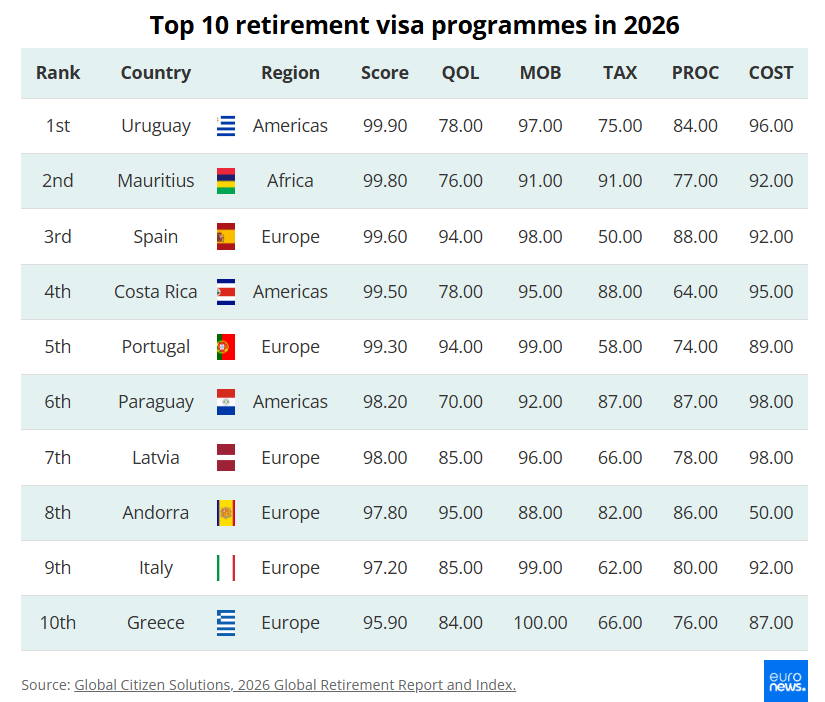
Uruguay has taken the top spot in a new global retirement ranking, overtaking last year’s leader, Portugal. But Europe remains the most represented region, with six countries in the top ten. The Americas hold three places, while Mauritius ranks second.

Global Citizen Solutions’ 2026 retirement index compares 46 retirement and passive-income residence programmes, assessing quality of life, travel freedom and routes to citizenship, taxation, application procedures and costs.

Europe’s strengths lie in its high living standards, strong passports and routes to citizenship, although higher taxes weigh on its scores. Spain, Portugal, Latvia, Andorra, Italy and Greece all make the top ten, with Portugal slipping to fifth this year.

Uruguay leads thanks to solid scores across all five categories, rather than coming first in any one of them. Mauritius follows, combining favourable taxation with good results elsewhere.

The report stresses that the right destination depends on each retiree’s priorities. Fewer than four points separate first and tenth place, making the leaders closely matched.


What are the major priorities for those retiring abroad?

Quality of life carries the most weight in the index, followed by mobility and citizenship, then taxation, application procedures and costs. The weighting reflects the priorities of a typical person retiring abroad, according to the report.


Europe performs strongly on quality of life and mobility but scores less well on taxation, with wide differences between its programmes. The Americas stand out for affordability and favourable taxation, while Mauritius leads Africa’s performance. In the Middle East, low taxes and fast processing are the main attractions. The United Arab Emirates, 19th overall, ranks first for preferential tax regimes. Spain, third overall, also scores strongly on mobility and options for moving with family members.

Strong passports and clear routes to citizenship help European and many Latin American programmes score highly. Gulf destinations offer favourable taxation and fast processing, but their retirement programmes provide no standard route to citizenship.

Europe’s top-performing programmes in the 2026 index

Europe’s ten highest-ranked international retirement programmes are those offered by Spain, Portugal, Latvia, Andorra, Italy, Greece, Austria, Albania, Cyprus and Malta. All ten rank in the top half of the index.

European programmes perform particularly well on quality of life and mobility. The trade-off is taxation. Spain, the best country in Europe to live abroad in retirement, ranks fifth in the world for quality of life and offers a smooth application process taking up to eight months. However, the country also ranks last out of 46 on tax, with worldwide taxation, regional wealth taxes and no special regime for visa holders.

Portugal ranks second in Europe. The country, which topped the global list in 2025, slipped to fifth place this year. This came as Portugal increased the number of years required for citizenship. In May, the requirement increased from five to ten years for most non-EU applicants.

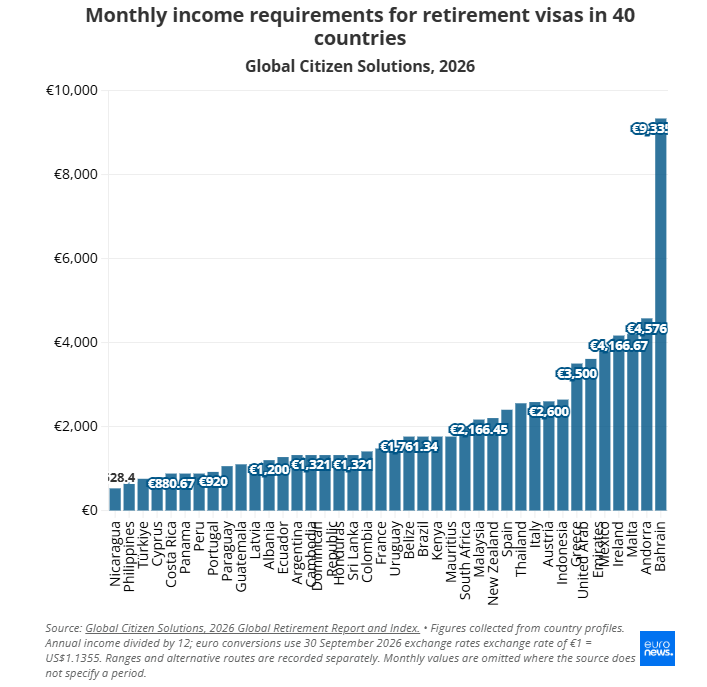
The qualifying sources of income are also important. In some cases, applicants must show foreign-sourced passive income or a pension; others accept savings or dividends. And while the income threshold may be relatively low, some routes also require savings, deposits, investments or other substantial upfront payments.

Cape Verde, Namibia, Chile, Zambia and Morocco are excluded from the chart because the report does not specify whether their income requirements are monthly. El Salvador is also excluded, as it gives separate thresholds for pensioners and people living on passive income. Income requirements in these countries vary between $825 and $1,800.

How quickly can you get a passport?

A route to citizenship is common, but not guaranteed. The report says 24 programmes offer naturalisation within five years and 17 within six to ten years. Andorra requires 20 years. Four — Malta, the UAE, Ireland and Bahrain — offer no standard route through retirement or passive-income visas.

The shortest timelines are in South America: around two years in Argentina and roughly three in Uruguay, Paraguay and some other countries.

However, 11 countries, including Austria, Andorra, the UAE and Malaysia, do not permit dual nationality, according to the report. Applicants may therefore have to give up their original citizenship. For those unwilling to do so, permanent residence may be the limit.

What other regions offer

The Americas stand out for affordability and favourable taxation. Brazil, Argentina and Chile also offer strong passports and relatively short routes to citizenship, adding to the region’s appeal.

Mauritius is Africa’s strongest performer. In the Middle East, the main attractions are low taxes and fast processing, although retirement routes offer no standard path to citizenship.

House prices keep rising across Europe: Which countries saw the biggest increases and why?

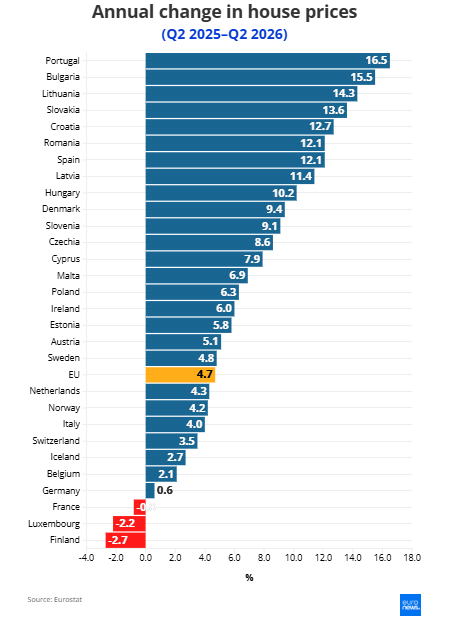
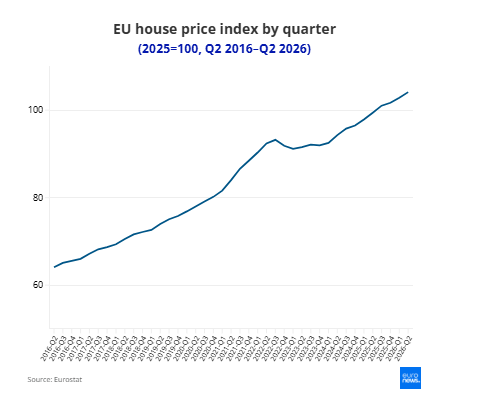
House prices in Europe continue to rise, outpacing inflation in many countries. Annual increases ranged from 0.6% in Germany to 16.5% in Portugal in the second quarter of 2026.

House prices continue to rise across much of Europe, but the pace varies widely. Portugal, Bulgaria and Spain recorded double-digit annual increases in the second quarter of 2026, while prices fell in Finland, Luxembourg and France.

Across the EU, prices rose by 4.7% compared with a year earlier, outpacing inflation of 3.2%.

So where are prices rising fastest, and how much of that growth remains once inflation is taken into account?

Over 15% rise in Portugal and Bulgaria

Among 29 European countries, nine recorded double-digit year-on-year rises in house prices, according to Eurostat. Portugal saw the highest year-on-year increase in the second quarter of 2026, at 16.5%, closely followed by Bulgaria (15.5%).

Mikk Kalmet, areal estate expert at Global Property Guide, noted that strong housing demand continues to outstrip supply in Portugal, particularly in Lisbon, Porto and popular coastal areas. “Limited new construction, foreign investment, tourism-related demand and persistent housing shortages have all contributed to rising prices,” he told Euronews Business.

Kalmet explained that in Bulgaria, rising household incomes, wage growth, relatively affordable mortgage financing and strong demand for property as an investment have supported price increases.

Lithuania (14.3%), Slovakia (13.6%), Croatia (12.7%), Spain (12.1%), Romania (12.1%), Latvia (11.4%) and Hungary (10.2%) also recorded increases of more than 10%.


Denmark (9.4%), Slovenia (9.1%) and Czechia (8.6%) were also close to the 10% level.

House prices also rose by more than the EU average in Cyprus (7.9%), Malta (6.9%), Poland (6.3%), Ireland (6%), Estonia (5.8%), Austria (5.1%) and Sweden (4.8%).

Three countries saw declines

Finland (-2.7%), Luxembourg (-2.2%) and France (-0.8%) were the only countries where house prices declined year on year over this period.

Mikk Kalmet pointed to weak economic growth in Finland, along with subdued consumer confidence and the lingering effects of higher interest rates.

“In France, affordability constraints, relatively weak housing demand and the effects of previously elevated mortgage rates have put downward pressure on prices,” Kalmet said, adding that economic uncertainty has also encouraged some prospective buyers to postpone purchases.


Among the EU’s ‘Big Four’ economies, Spain stands out with a 12.1% rise, while Italy (4%) is below the EU average. Germany recorded only a slight increase of 0.6%, just above France, where house prices fell by 0.8%.

“[In Germany] higher mortgage rates are back. Housing affordability is deteriorating. Demand for mortgage loans is weakening,” Carsten Brzeski and Franziska Biehl from ING wrote in their analysis.

Local fundamentals drive Europe’s housing divide

Kalmet pointed out that the different rates of house price growth largely reflect national housing shortages, income growth, mortgage conditions and demographic trends. “Housing markets are fundamentally local, even though European countries share many of the same economic and monetary conditions,” he said.

Countries experiencing strong demand and limited construction tend to see faster price increases. In contrast, countries with weaker economic growth, subdued household demand or greater sensitivity to borrowing costs have experienced slower growth or declining prices.

Growth is still strong in real terms

When inflation is taken into account, real house price growth is still strong in many countries.

In the EU, with inflation at 3.2%, house prices rose by 1.5% in real terms.

However, growth remained much stronger in several countries. In Portugal, for example, inflation was 3.6% over this period, resulting in real house price growth of 12.1%.

Real growth was also above 7% in Slovakia (9.4%), Bulgaria (9.1%), Lithuania (8.8%), Spain (8.3%), Latvia (7.9%), Denmark (7.7%), Hungary (7.7%) and Croatia (7.5%).

Six countries recorded declines in real terms, led by Luxembourg with a fall of 6.4%. Real house prices also fell by 3.2% in France and 2% in Germany.


Explaining what has driven house prices over this one year, Kalmet said: “Three factors stand out: persistent housing shortages, household income growth and changing mortgage conditions. In many European countries, residential construction has failed to keep pace with housing demand.

What’s next for house prices?

Kalmet expects that persistent housing shortages and continued demand could support further price increases in many European markets. However, growth is likely to remain uneven, and another year of double-digit increases should not be taken for granted.

“The biggest uncertainty is interest rates. The ECB raised rates in September 2026 in response to renewed inflationary pressures. Higher mortgage costs, combined with weaker purchasing power caused by rising energy prices, could slow housing demand,” he said.

Brzeski and Biehl noted that prospective buyers in Germany now face a challenging combination of higher property prices, higher financing costs and the lingering effects of weaker real purchasing power, driven by the adverse economic effects of the war in the Middle East.

Creditline: Euronews Business

This industry adds €65 billion to the European economy, but is its bad reputation fair?

The cruise industry is attracting younger travellers, but how is it addressing concerns over emissions and overtourism?

In recent years, we’ve seen demonstrations at ports across Europe against the cruise industry over environmental and overtourism concerns.

But has the cruise industry unjustly become the poster child for the travel industry’s problems, and can it repair its dirtied reputation?

In this episode of The Big Question, Gianni Onorato, CEO of MSC Cruises, sat down with Hannah Brown to discuss how the cruise industry is responding to its biggest criticisms to ensure its survival.

How big is the cruise industry?

Gianni stressed that while their ships may be big, the cruise industry is not, with this segment making up less than 2% of the travel packages sold globally in 2025.

And while we’ve seen overtourism complaints in Barcelonablamed on cruises, their passengers only account for around 3% of the city’s daily visitors.

Despite this, cruise companies are working hard, like the rest of the travel industry, to take passengers to new destinations and spread tourist arrivals more evenly throughout the year.

Unlike airlines, which confirm their flight schedules less than 12 months in advance, cruise itineraries are set two years ahead to help destinations plan for the incoming visitors.

“The predictability of cruises allows small family businesses to decide if they want to add, for example, more tables and seats in their restaurants or in their bars because they know that it’s for sure that they will have these people coming,” Gianni explained.

And the industry has become a vital part of the European economy, providing more than 445,000 permanent jobs across the continent.

Scaling up technology to clean up cruising

But overtourism isn’t the only worry. People are also critical of the cruise industry’s carbon emissions.

The most significant development to clean up the industry is the roll-out of dual-fuel engines, capable of seamlessly switching between traditional marine fuel and cleaner alternatives.

“In 2023, one of our ships, the MSC Euribia, had a four-day cruise from Le Havre to Copenhagen using biofuel and it was proved that together with other innovative measures for fuel consumption reduction, we were able to reach the target of zero,” Gianni explained.

Members of the Cruise Lines International Association (CLIA) operate 327 ships, accounting for about 90% of global cruise capacity. Only 30, or around one in 11, are equipped with dual-fuel engines, up from a single ship in 2018.

And although this is progress, it is slow. This is partly because affordable cleaner fuels are in short supply and partly because companies have to wait until the end of a ship’s 30-year lifespan to upgrade their fleet.

Gianni was confident, however, that most of the remaining ships in service will have been decommissioned and replaced in time to meet the EU’s target of a climate-neutral maritime industry by 2050.

In the meantime, he spoke passionately about the other technologies being retrofitted in the current fleet to dramatically reduce energy consumption on board.

“The air conditioning on the ship today is through an HVAC inverter that gives the opportunity to automatically regulate the level of air conditioning according to the number of people present in the room,” Gianni told The Big Question.

Cruise passengers are changing

While technologies, fuels and destinations have been changing, so too has the cruise industry’s clientele.

“In the past, cruises had this perception for being for old people. While now, there is a much younger demographic. The average age is 35-54 and this is very good because this can ensure the future of this industry,” Gianni explained.

He also added that solo travellers are a growing market for the company, with safety becoming an increasingly important consideration. Multi-generational holidays are also growing in popularity, allowing family members to enjoy separate activities as well as spending time together.

But the industry isn’t about to suddenly boom.

Almost all of the world’s cruise ships are built in Europe, with the four major shipbuilders based in the bloc: Italy, France, Germany and Finland. But the production is limited, so demand is likely to outpace supply.

While some might see this as negative, Gianni pointed out that it means the industry has controlled growth – a good thing for investors and its long-term future.

Creditline: Euronews Business